Modern wind energy demands have reshaped how we approach tower manufacturing. After working alongside fabricators producing 150+ tower sections monthly, I've seen firsthand how the right plate rolling equipment transforms production lines from bottlenecks into competitive advantages.
The challenge isn't just forming thick steel—it's maintaining sub-millimeter accuracy across 20-100mm plate while meeting aggressive delivery schedules. This is where CNC automation separates high-volume manufacturers from shops struggling with rework rates.
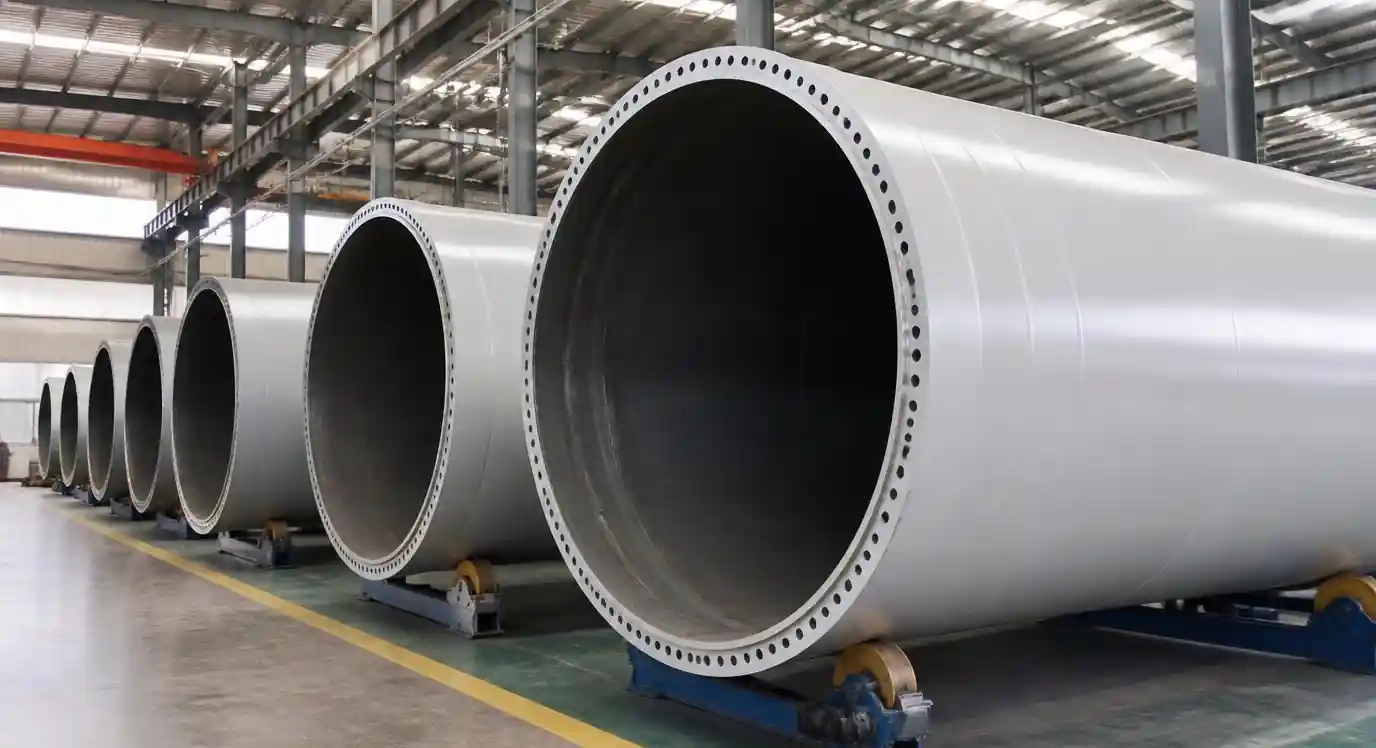 Wind tower sections on manufacturing floor showing thick steel plate cylinders
Wind tower sections aren't forgiving. A single 30-meter section requires forming 60-80mm plate into cylinders with diameter tolerances of ±0.5%—that's roughly 8mm variance on a 16-meter circumference. Manual hydraulic machines can't consistently hit these specs at production volume.
The industry moved to dedicated wind tower plate rolling machines because standard equipment couldn't handle three simultaneous requirements: thickness capacity beyond 80mm, working lengths exceeding 12 meters, and diameter repeatability measured in decimal points rather than percentages. According to the American Wind Energy Association, the demand for precision tower manufacturing continues to grow with turbine sizes reaching 15+ MW offshore.
Most fabricators underestimate the compounding effects of automation. The difference isn't just operator convenience—it's measurable throughput.
Table 1: Manual vs CNC Plate Rolling Performance Comparison
| Performance Metric | Manual Hydraulic System | CNC Servo System | Improvement |
|---|---|---|---|
| Setup Time per Section | 45-60 minutes | 12-15 minutes | 73% reduction |
| Diameter Accuracy | ±1.5-2.0% | ±0.3-0.5% | 4x improvement |
| Operator Skill Required | 3-5 years experience | 6 months trained | Faster onboarding |
| Rework Rate | 8-12% | 1-3% | 75% reduction |
| Energy Consumption | 100% baseline | 60-70% | 30-40% savings |
| Production Cycle Time | 6-8 hours/section | 3.5-4 hours/section | 40-50% faster |
The cycle time reduction comes from three areas: pre-programmed bending sequences eliminate trial-and-error, servo motors respond 8x faster than hydraulic valves during adjustment, and real-time diameter feedback prevents progressive error accumulation.
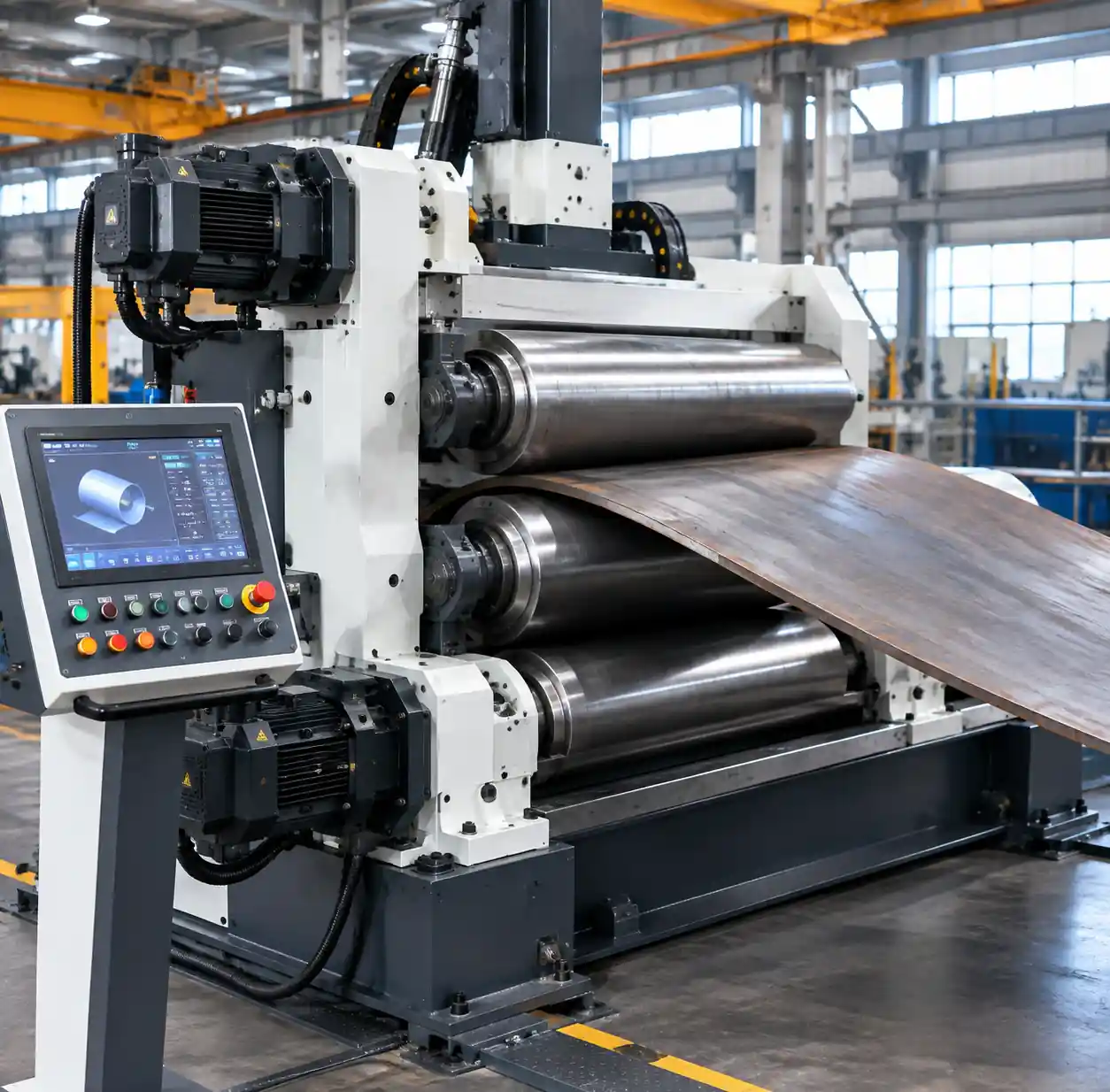 CNC servo plate rolling machine forming thick steel plate for wind tower section
Forming thin-wall sections (20-30mm) on equipment sized for thick base sections (80-100mm) creates problems. Thinner material requires different roller pressure distribution—too much force causes roller marks, too little produces inconsistent curvature.
CNC servo 4-roll machines store pressure profiles for each thickness range, automatically adjusting clamping force between specifications. Manual machines require 15-20 minute operator adjustments by feel, introducing variation.
Base sections at 80-100mm thickness push equipment to maximum capacity. The critical factor is deflection control—frame flex reaching 2-3mm at roller centerline translates directly to diameter error. Wind tower equipment incorporates frame reinforcement and compensating crowning that standard machines lack.
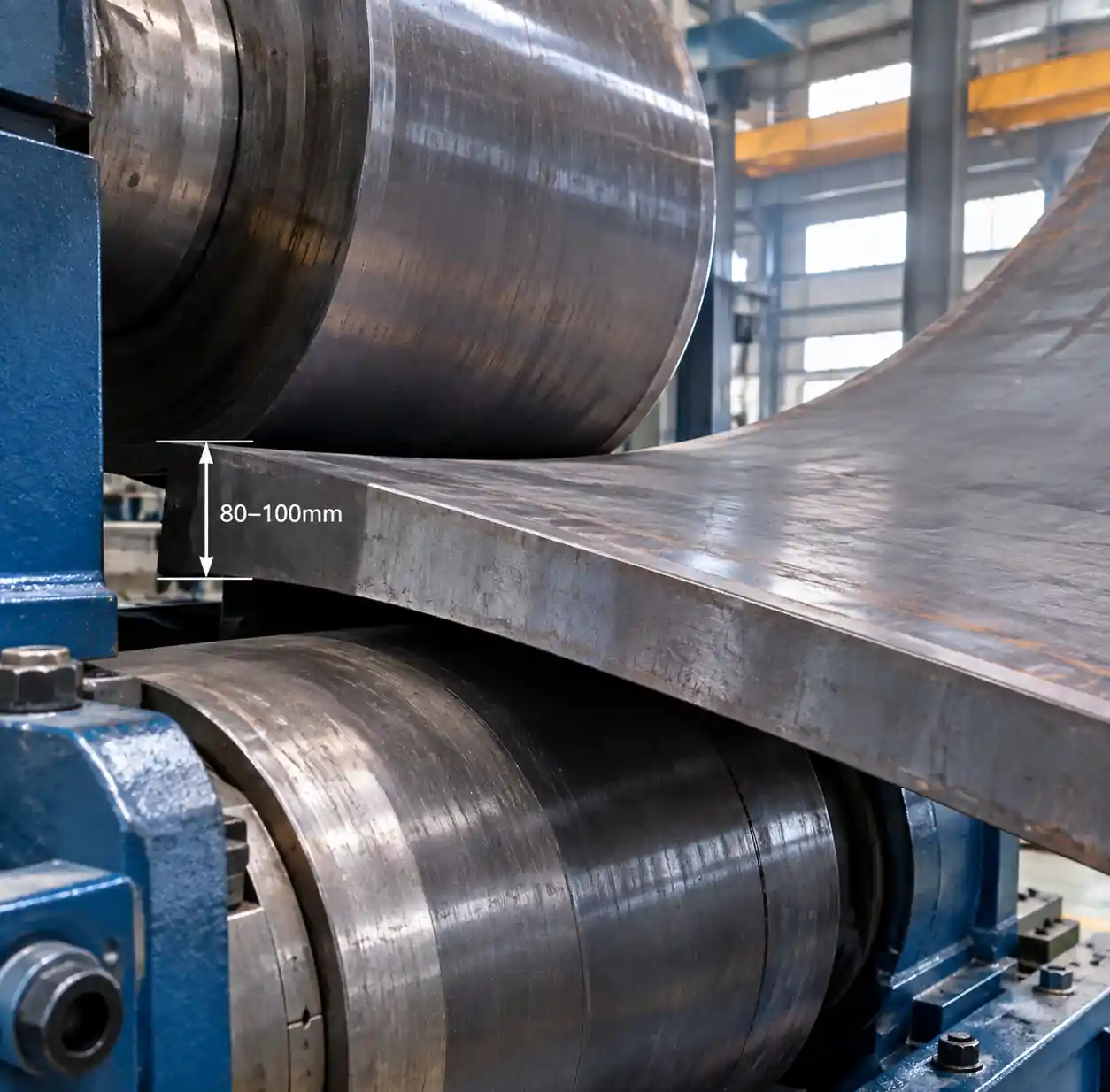 Heavy gauge 80-100mm steel plate being formed for wind tower base section
Meeting ±0.5% diameter tolerance across a 12-meter section requires controlling six variables simultaneously:
CNC systems manage all six through closed-loop control. Manual operations rely on operator judgment for items 1, 3, 4, and 6—which explains why experienced operators command premium wages in markets where they still exist.
Table 2: Factors Affecting Diameter Accuracy in Wind Tower Production
| Factor | Impact on Accuracy | Manual Control | CNC Control |
|---|---|---|---|
| Springback Compensation | ±0.8-1.2% | Operator experience-based | Material database + sensors |
| Roller Parallelism | ±0.3-0.5% | Mechanical adjustment | Servo positioning ±0.02mm |
| Feed Rate Variation | ±0.2-0.4% | Hydraulic valve response | Electronic velocity control |
| Temperature Effects | ±0.1-0.3% | Shop environment dependent | Can integrate preheating |
| Crown Compensation | ±0.2-0.6% | Fixed crown grinding | Programmable CNC crowning |
| Edge Pre-bending | ±0.3-0.7% | Separate operation | Integrated in forming cycle |
The EZHONG approach uses real-time diameter measurement through laser tracking that feeds back to roller positioning. When diameter deviates beyond 0.2% tolerance, the system micro-adjusts in 0.01mm increments during rolling rather than discovering errors during post-forming inspection.
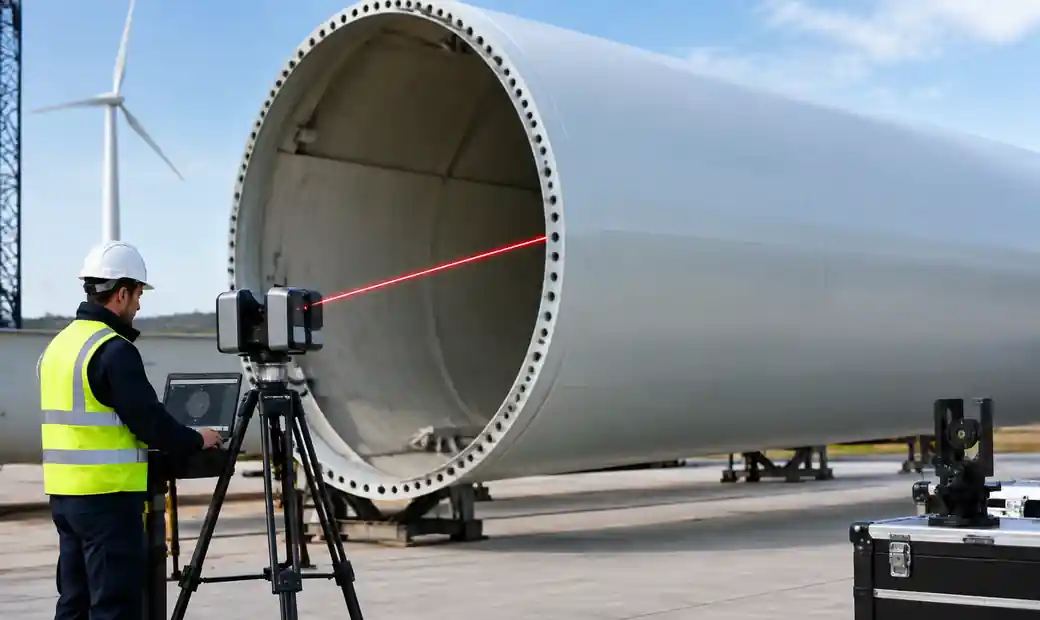 Laser measurement system checking wind tower section diameter accuracy
After analyzing production flows at facilities running both systems, material handling consumes 35-40% of cycle time in manual operations. Automated systems with integrated loading gantries cut handling time from 90 minutes to 25 minutes per section.
Pre-bending represents another 20-25% of manual cycle time. Four-roll CNC machines eliminate separate pre-bending by clamping material between upper and side rollers before initial forming.
Post-forming fit-up accounts for 15-20% when diameter accuracy falls outside specification. CNC-formed sections arrive at welding within 0.3% tolerance, allowing automated tack welding. Manual-formed sections often require shimming or pressing to achieve weld gap consistency.
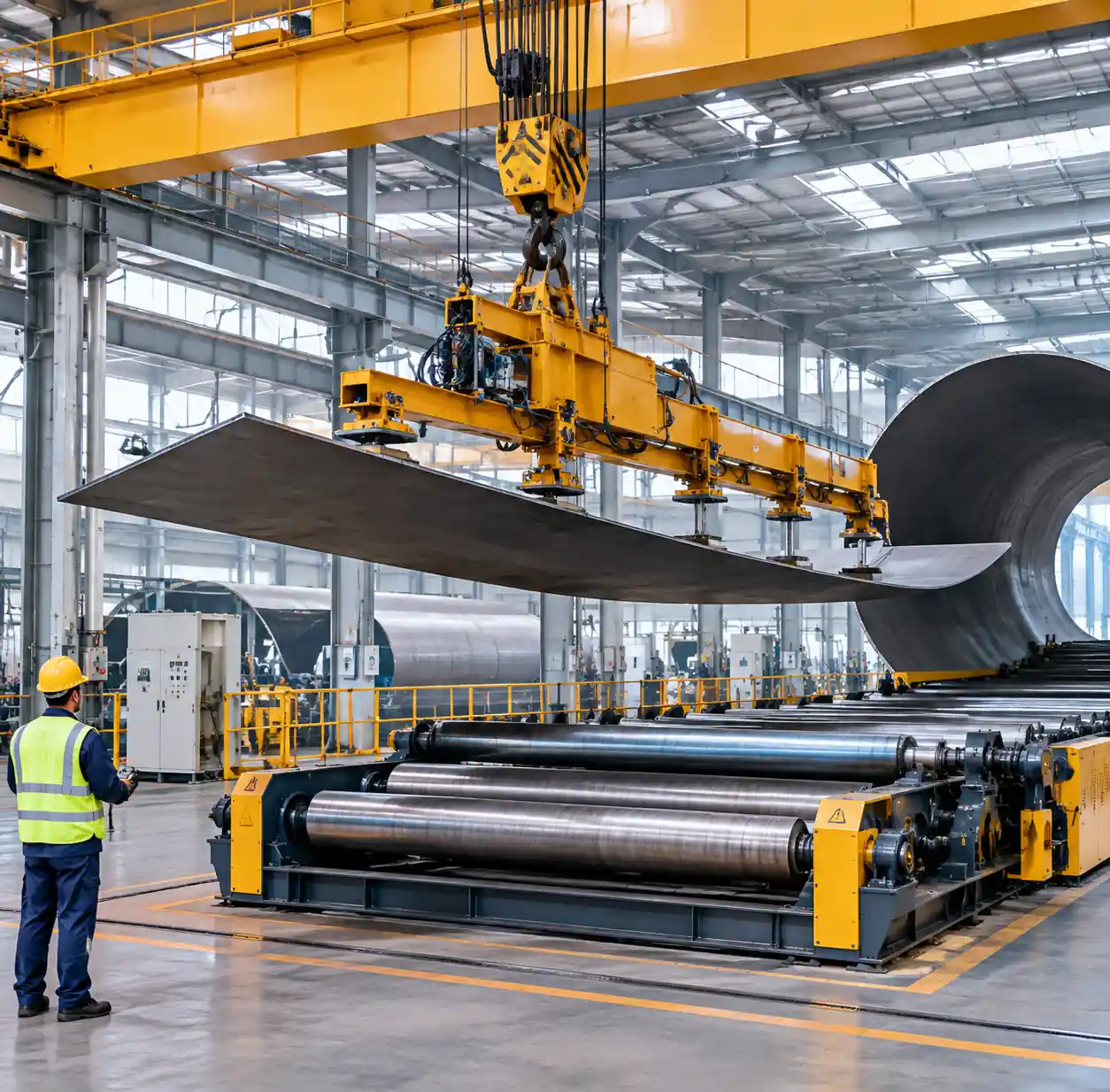 Overhead gantry crane or automated material handling for plate rolling production
A North American fabricator producing 120 tower sections monthly switched from manual 3-roll hydraulic machines to CNC servo 4-roll equipment. Their production data over 12 months revealed:
The ROI period was 26 months based on labor and rework savings alone. Including penalty avoidance for on-time delivery, equipment paid for itself in 18 months.
Most significantly, the facility went from declining contracts for thick-wall sections to actively bidding on large-diameter offshore wind projects. The capability upgrade changed their market positioning.
Selection depends on production volume, section diameter range, and material specifications.
Shops producing under 30 sections monthly with diameters below 4.5 meters and thickness under 60mm can use standard 4-roll hydraulic machines with digital readouts. Mid-volume producers (30-100 sections monthly) with variable specifications benefit from CNC servo systems—programming enables quick changeovers without operator retraining.
High-volume facilities (100+ sections monthly) or offshore wind tower producers (diameters exceeding 6 meters, thickness beyond 80mm) require fully-integrated automated lines where equipment uptime and consistent quality matter more than labor cost per section.
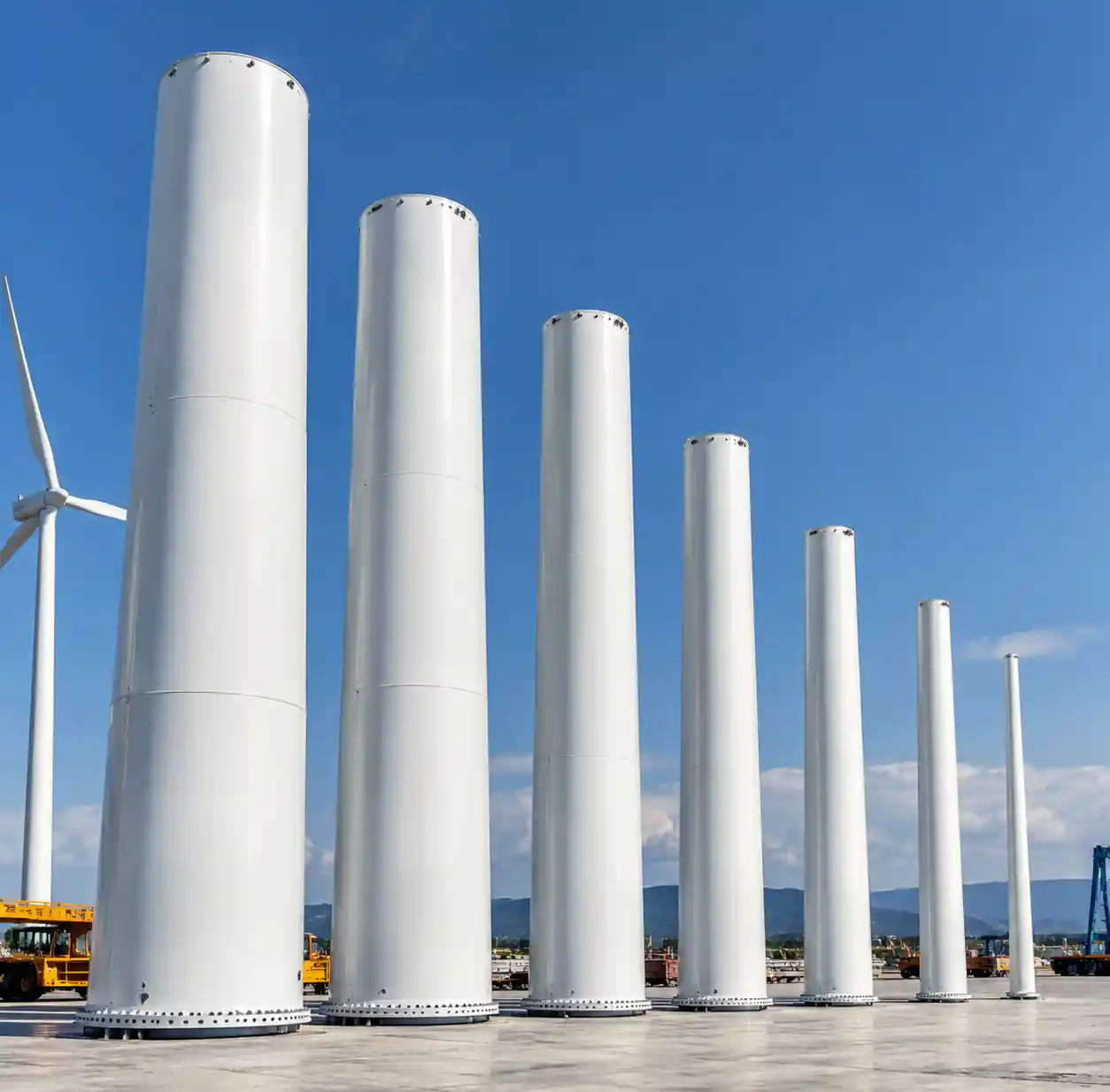 Multiple wind tower sections showing varying diameters from base to top segments
The faster cycle time from CNC equipment often reveals welding or coating as the new bottleneck. Leading manufacturers use parallel welding stations or automated submerged arc welding cells that match rolling throughput.
CNC machines consume plate faster than manual cranes can deliver it. Facilities seeing full cycle time improvement invest in overhead traveling gantries or automated guided vehicles for staging.
Quality control integration matters critically. CNC-formed sections with ±0.3% accuracy require measurement systems that can verify that tolerance—manual tape measurements have ±5mm error. Laser measurement or coordinate measuring machines become necessary, not optional.
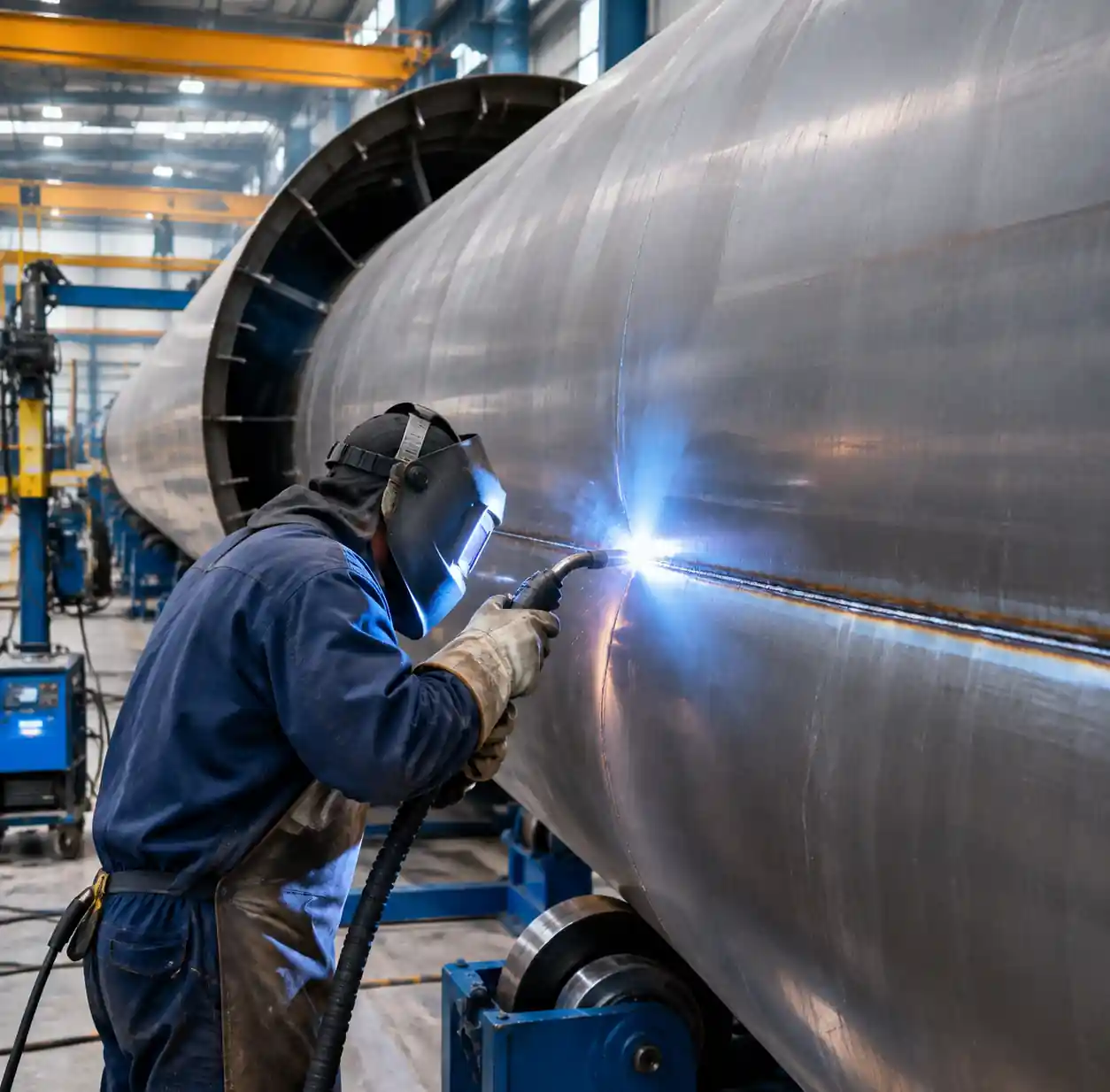 Longitudinal welding operation on formed wind tower section showing fit-up quality
CNC servo systems eliminate most hydraulic fluid issues (contamination, leaks, temperature sensitivity) but introduce encoder calibration and electrical system upkeep.
Roller bearing inspection depends on loading intensity. Wind tower production with constant heavy-gauge work requires bearing checks every 2,000 hours versus 4,000-hour intervals for lighter work. Bearing failure creates scrapped sections and multi-day downtime.
CNC control systems need annual calibration verification. Roller position accuracy degrades through wear and thermal cycling—annual checks catch 0.05-0.1mm drift before it affects quality. Software updates often include improved material compensation algorithms, improving forming accuracy by 0.1-0.2% without hardware changes.
Q: Can I use standard plate rolling machines for wind tower production instead of specialized equipment?
Standard machines lack three critical capabilities: sufficient thickness capacity (most top out at 50-60mm), working length adequate for tower circumferences (wind sections need 12+ meter capacity), and the frame rigidity to maintain accuracy under high forming loads. The International Renewable Energy Agency notes that specialized forming equipment is essential for meeting modern wind tower specifications.
Q: How long does operator training take for CNC plate rolling systems?
Basic operation training takes 3-5 days. Competent independent operation requires 4-6 weeks including troubleshooting and material variation handling. Compare this to 3-5 years for manual hydraulic machine mastery. The CNC system's material database and automated compensation eliminate much of the craft knowledge requirement.
Q: What's the realistic ROI timeline for upgrading from manual to CNC equipment?
Mid-volume manufacturers (40-80 sections monthly) typically see 24-30 month payback from labor reduction and rework elimination. High-volume shops (100+ sections) can achieve 16-20 month ROI. Low-volume producers (under 30 sections monthly) may require 36-48 months unless rework rates are exceptionally high or operator recruitment is a persistent challenge.
Q: Do CNC systems handle the transition from thick base sections to thin top sections within one tower model?
Yes—this is where CNC excels. The system stores pressure profiles for each section thickness and automatically adjusts when you load the next specification. Manual machines require operators to recalibrate pressure settings, adding 15-25 minutes per thickness change and introducing error potential.
Q: What maintenance costs should I budget for CNC servo plate rolling machines?
Annual maintenance costs run 2-3% of equipment purchase price for routine work (bearings, encoders, calibration). Budget an additional 1-1.5% for unplanned repairs. Hydraulic systems have similar total maintenance costs but different failure modes—expect more seal and valve work, less electrical troubleshooting.
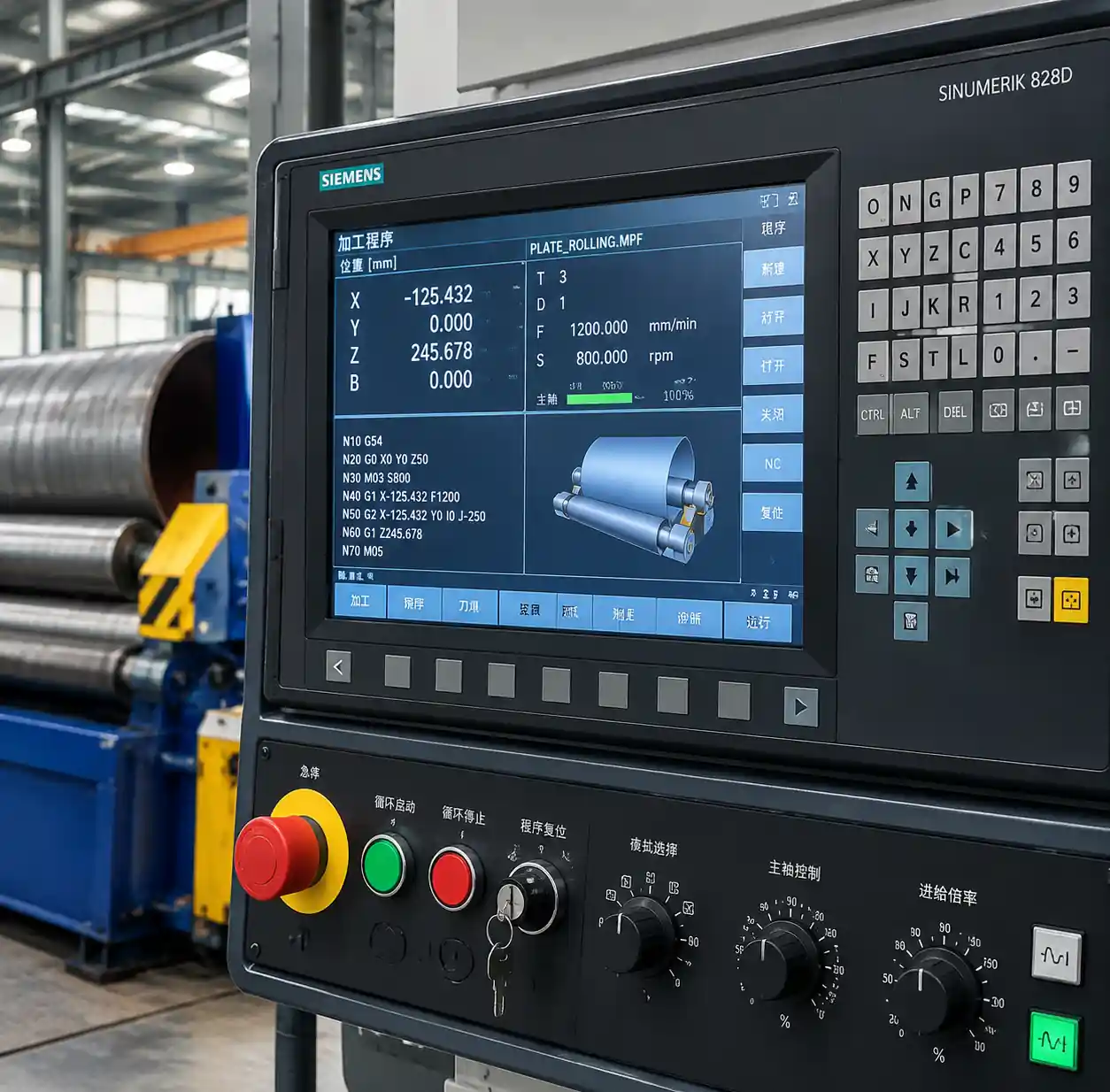 CNC control panel displaying programming interface for plate rolling parameters
Wind tower manufacturing efficiency hinges on controlling three variables: dimensional accuracy, cycle time, and operational consistency. CNC plate rolling machines address all three through closed-loop servo control, material-specific programming, and automated compensation that manual systems cannot replicate.
The 40% cycle time improvement manufacturers experience comes not from faster roller rotation but from eliminated rework loops, reduced setup time, and consistent quality that prevents downstream bottlenecks. For shops producing 50+ sections monthly, the labor savings and penalty avoidance justify equipment investment within 24 months.
The transition from manual to CNC operation requires more than equipment purchase—successful implementations upgrade material handling, quality verification, and downstream welding capacity to match the forming machine's new throughput. Organizations that treat this as an integrated production system upgrade rather than isolated equipment replacement capture the full efficiency potential.
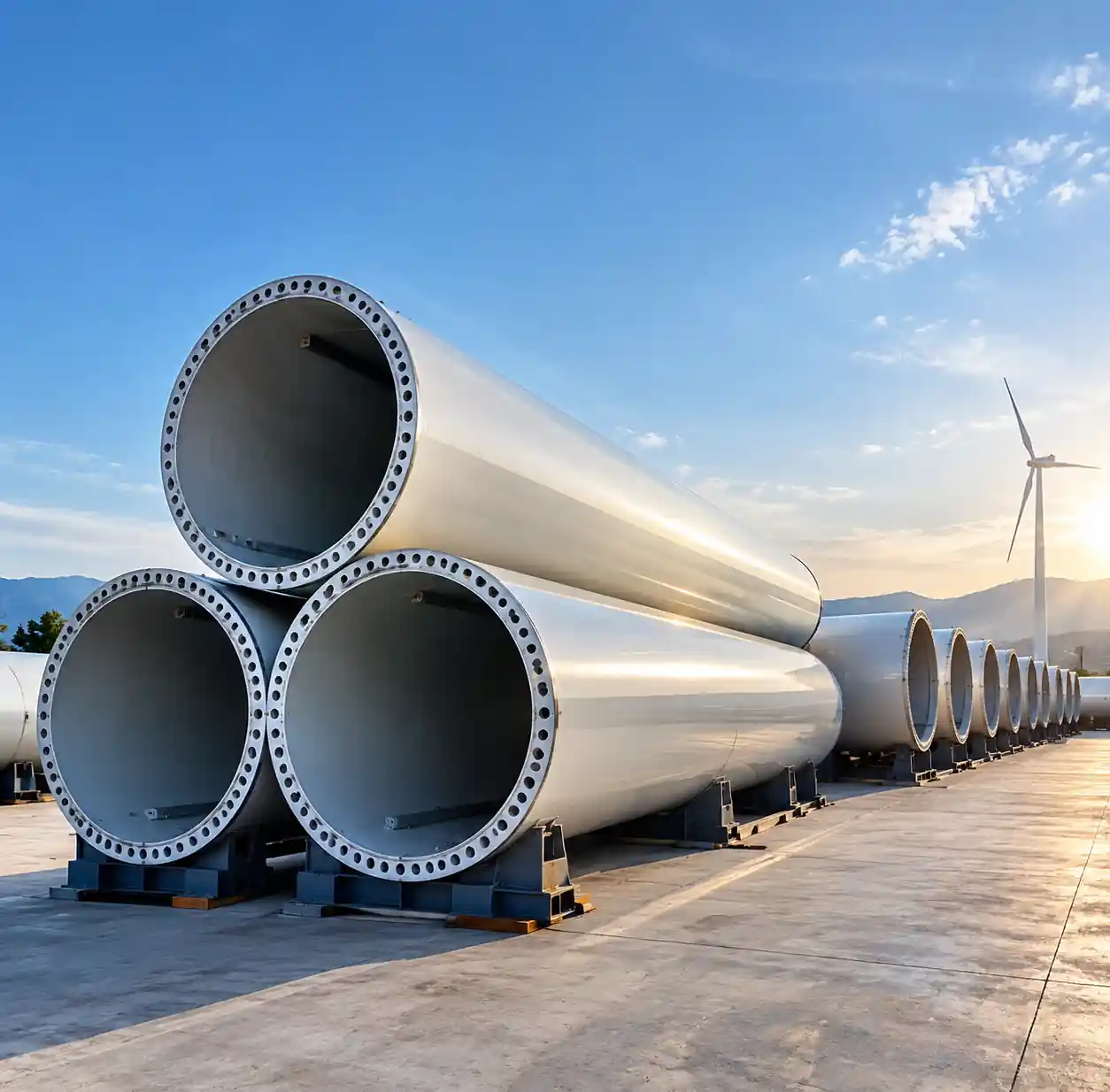 Completed wind tower sections staged for quality inspection and shipping